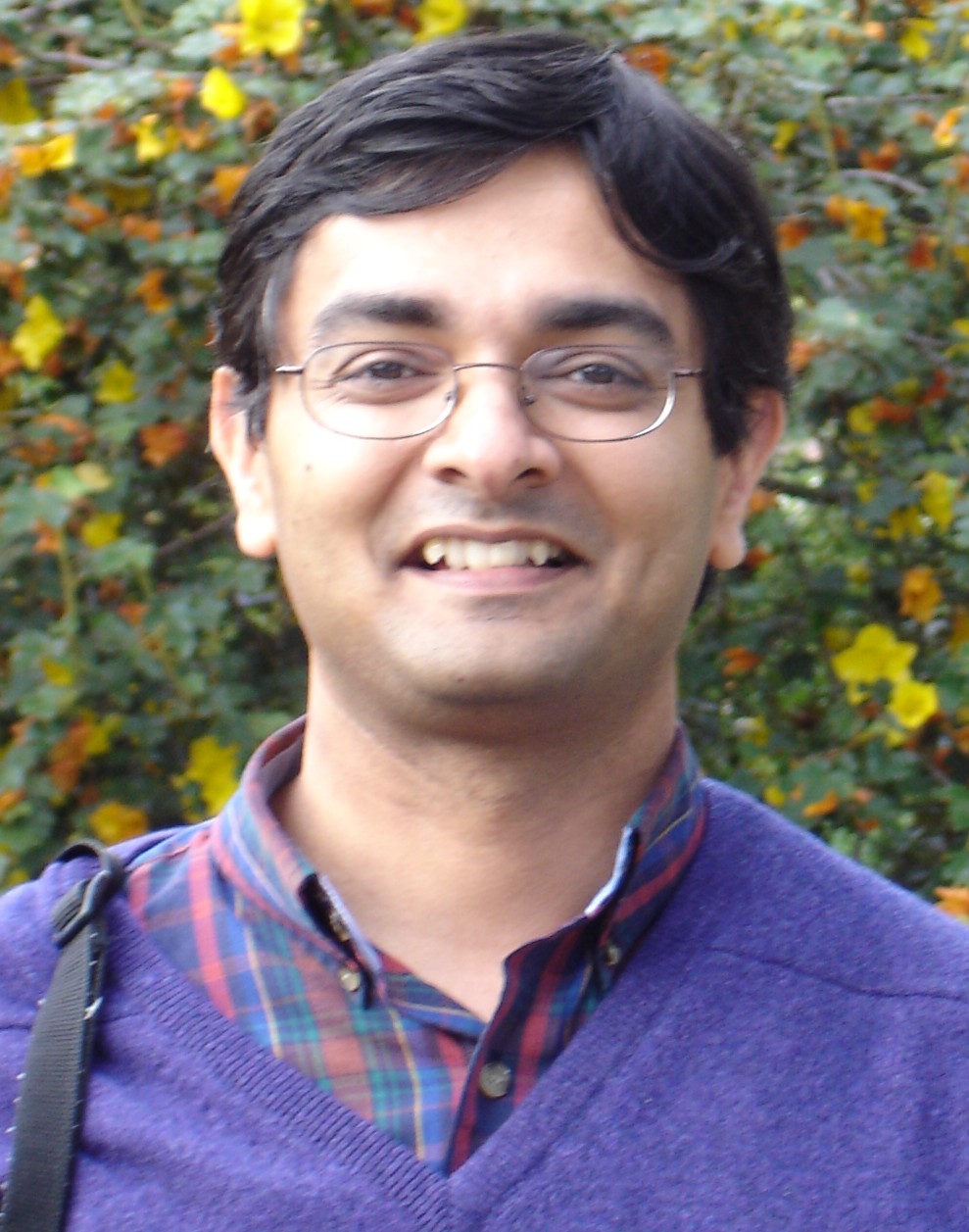
 Sachin
Sapatnekar received the B. Tech. degree from the Indian Institute of Technology,
Bombay in 1987, the M. S. degree from Syracuse University in 1989, and
the Ph. D. degree from the
University of Illinois at Urbana-Champaign in 1992. He has
worked at Texas Instruments during the summer of 1990, and at
Intel Corporation during the summer of 1997. His other major
educational qualifications include self-taught basic juggling
under the long-distance tutelage of the world-renowned Klutz
School in 1991, and the PADI
Open Water Diver Certification from Deep Sea Divers Den in
2001. With his once-a-decade average of trying something new, he
is sure to remain his same old boring self until 2011. So boring
that it's well past 2011, and this hasn't been updated.
Sachin
Sapatnekar received the B. Tech. degree from the Indian Institute of Technology,
Bombay in 1987, the M. S. degree from Syracuse University in 1989, and
the Ph. D. degree from the
University of Illinois at Urbana-Champaign in 1992. He has
worked at Texas Instruments during the summer of 1990, and at
Intel Corporation during the summer of 1997. His other major
educational qualifications include self-taught basic juggling
under the long-distance tutelage of the world-renowned Klutz
School in 1991, and the PADI
Open Water Diver Certification from Deep Sea Divers Den in
2001. With his once-a-decade average of trying something new, he
is sure to remain his same old boring self until 2011. So boring
that it's well past 2011, and this hasn't been updated.He was an Assistant Professor in the Department of Electrical and Computer Engineering at Iowa State University from 1992 to 1997. He is currently a Professor in the Department of Electrical and Computer Engineering at the University of Minnesota, where he holds the Robert and Marjorie Henle chair and the Distinguished McKnight University Professorship. His current research interests lie in developing efficient techniques for computer-aided design of integrated circuits, and are primarily centered around physical design, timing and simulation issues, and optimization algorithms. He has served on the editorial boards of several IEEE journals, including as Editor-in-Chief of the IEEE Transactions on CAD. He was a Technical Program Co-chair in 2006 and 2007 for the Design Automation Conference (DAC), and the General Chair in 2010. He has also been the Technical Program Chair and General Chair for the International Symposium on Physical Design (ISPD) and the Tau workshop, and Program Chair for the International Conference on VLSI Design in India. He is a recipient of the NSF Career Award, the SRC Technical Excellence Award, the SIA University Research Award, Best Paper Awards at the DAC'97, ICCD'98, DAC'01 DAC'03, ISPD'09, ISQED'10, ASYNC'16, ISQED'19, and ICCAD'21 conferences, a Best Poster Award at IRPS'12, and the ICCAD Ten-Year Retrospective Most Influential Paper Award in 2013 and 2016. He has been a Fulbright Senior Researcher at Universitat Politècnica de Catalunya in Barcelona in 2013, and a DJ Gandhi Visiting Professor at the Indian Institute of Technology, Bombay in 2014. He is a Fellow of the IEEE (2003) and the ACM (2016).
To see a list of his publications, click here